So today I wrote a short story. It fills about six pages in my notebook: tough to read, makes chickens mad when you compare it to chicken-scratching, not well thought out. Based on me and my first world problems.
The story is this blog entry because I am trying a bit of writing advice that goes like this: the first thing you put on paper is going to be mostly crap. Accept this fact, and court it. And remember that hidden in this crap draft will be diamonds. The first part of your job as a writer is to just strain and push and get it all out there.
Then you have to leave it alone for a while. Because as a writer, you fall naturally in love with your crap draft. You have to let it cool off a bit, go do something else. It will stop feeling like a part of you once it has a chance to age a bit. Then you can dig into it, look at it with fresher, more vicious eyes.
So I've closed the notebook, and won't look back until next week. Then I will type it out, and hopefully in that process discover what worth it has, if any. I suspect that it will end up being a bit of flash fiction (less than 1,000 words). Frankly, the plot is not capable of carrying more than that, and may not even make it to half. The character (only one) is like an even more annoying and whiny and foolish version of myself, and could be outlined in two sentences, one of which you are reading now. The setting has promise, but you can't base a story on scenery alone.
Anyway, once I get the second draft up and running, I will decide whether or not to put it up here. Maybe get some feedback from my peeps first. But what I wrote first is not here, because only infants and toddlers bring you a handful of crap first draft and expect you to smile.
The writing advice, by the way, comes from the excellent Writing About Writing blog. I would also say that the scatological bent comes from there, but those who know me will be doubtful, and those who don't might do research.
First a disclaimer: this is not a post about Jim Morrison's group. Those boys were very talented, and the idea of teaching "Riders on the Storm" to a class is still very amusing to me.1
Nope. The title of this post is based on the photos in it, many of which are doors. I arrived forty minutes early for a lesson last week, and decided to take a walk. I was not very familiar with the neighborhood, and the rain was off bothering someone else, so I got off the main road and took a look around.
I was inspired by my friend Aaron Klenke, of Detroit MI. I believe he just wanders around during his lunch break taking pictures of things he finds interesting. And one set of his photos was doors. I found them fascinating, and it occurred to me that you, dear reader, might find some of the doors here in Busan fascinating as well.
Not a fun walk, but scenic.
The doors I'm showing you today are all from this walk. To me, they are mostly familiar, though not unremarkable. They share another thing in common which I failed to capture with the lens:
They all open up directly onto the street, unless you can clearly see otherwise. In taking these photos, I did not trespass, or walk up anyone's driveway.
Isn't this the same as the
other door, but painted white?
I did, however, walk up a serious hill. The photo doesn't do it justice. In Busan I don't think you can move more than a mile in a straight line without either going up a hill or into the sea.
Definitely not Kansas.
Which is the one thing that I bounce back and forth between loving and hating about Korea. It's not familiar, and that is frustrating at times. But it's also fascinating, and exciting, and fun.
I'm a bit amazed to find that I still feel that way after more than fifteen years. The frustration is still real, but it is mostly a background noise level of annoyance. It's like having a temperamental car for a long time, the kind where you have to jiggle the key just right to get it out of the ignition, and pump the gas just right to start it, and you can't unlock the driver's side door. But it is predictably difficult, and it gets you where you are going. And you have a history with it, driving your friends around, shopping, road trips.
The big difference is that a car wears out; the problems get worse, not better. But many of Korea's problems are improving: Busan is way more foreigner-friendly than when I first arrived, part of which includes many people being able to speak English. There are bike lanes in some places and a public bicycle program that has cute yellow bikes all over the place (though not in any of my pictures). The food situation is unbelievably better, including restaurants and groceries.
The same hill from further up. I walked up that road and didn't die!
Busan has become objectively more comfortable for foreigners, and I have adapted to it as well. I am comfortable enough to stay, but uncomfortable enough to be a bit challenging.
A very common,
short, cheap, door.
I still find neighborhoods like this interesting. I have heard people say that walking around these neighborhoods is boring, that they are all the same. True, they are often composed of the same elements, but isn't all of life?
I love seeing how people have adapted to the space that is available. It's fun to see homes that are so very clearly made by human hands. I know, it's all made by people, but in the photo of the hill above you can see some big apartment blocks. How much fun is it to walk around in one of those? And those are not the really big ones. Our current home is across from LG Metro City. (That's a Google Map link.) It is a complex of about a hundred big apartment buildings, in the 30 story range, I think.
It's a good use of space. I understand that the environmental impact is less than when people are spread out all over the place. But when you walk around LG Metro City it feels like a maze of twisty concrete passages, all the same. With minor landscaping differences.
Former house, now garden. Someday likely an apartment.
I suspect that lots like this are bought up by developers.
Step right out onto asphalt. Be sure
to look both ways!
But these homes are different. There is some variation in style, building material and color, their shapes fit the landscape, and they don't all stare out at the road with identical concrete and glass faces.
They clearly date from a time when cars were for rich people: there are few parking spaces, and you often have to walk past a few houses to get to the street. I've lived in a house like this here in Busan. In the summer, your windows are all open because air conditioning is also for rich people. You can smell what the people in nearby houses are cooking, and hear their rice cooker hiss. If your Korean is better than that of a toddler, you can probably understand what they are saying (I couldn't). When you go in and out you bump into them, and you can hear their kids playing, complaining, crying, living.
In neighborhoods like this people often leave their doors open, for ventilation, or because they are going in and out. There is always a mudroom, usually with a shoe closet. They don't deal with very much mud, but the concept is the same: dirty shoes don't come all the way inside. House slippers, socks or feet only on the floor.
My family will be moving to a different home in less than two weeks. On moving our current home will feel violated because from the time the first objects get removed until the last object is placed, the door will be propped open and people will be wearing shoes inside. I will be wearing shoes inside, and I know from experience that it feels wrong, like swearing in front of your mom.2 It's odd how much of a difference it makes seeing your home without feeling it in the soles of your feet. And even though my shoes don't add more than an inch of height, I feel like I need to be careful going through the doorways, as though I am a giant invading my own home.
A hilltop neighborhood. To the right, homes, to the left, the roofs of homes.
Doors are fascinating. We feel such a strong need to divide spaces, especially private from public. When I lived in Nepal, I found that the culture there was much less divided. The family found it somewhat strange that sometimes I would go into my room and lock the door. They kind of sort of accepted that I slept in a room by myself, but I think I was still considered eccentric for not sleeping in the room with the other boys.3
Looking over the roof tops from the road. You can see some of the same
buildings on the hill in the background as in the previous picture.
Monster cat door? Coal delivery?
Who knows?
During the day, most people in the villages left their homes open. They would often be nearby, working in the fields, collecting wood for the fire, carrying water, or doing other necessary chores. The women were almost always nearby. When I walked places, it was very common to find houses with the door open, and no one in sight. At first I always locked my door when I went to work, but it started to feel weird, far too paranoid. So I stopped.
When you live in a different culture, you have to have some sort of separation. Everyone does. The two main questions are: "Where do you draw your lines?" and "How militantly do you defend them?"
I suppose a third question could be "How flexible are your lines?" but it seems to be a blend of the first two questions to me. I consider my younger self to have been very flexible, though far from extremely so. The extremely flexible volunteers stayed, got married, took Nepali nicknames, wore Nepali traditional clothes. I shut my door to those things.
Matching door and window. I can
guarantee there is a bathroom
behind the window.
I came directly to Korea from Nepal, and stayed for a couple of weeks to visit with my friend, Andy. I then spent three months in America4 before returning to Korea to get a job. In Nepal, I spent much of my first year isolated, surrounded by Nepalis (or Nepalese, as non-Nepali like to say). In Ranitar, there were no other foreigners. It was a village, so there weren't really that many other people. During my second year I stayed in a few different places, worked with other volunteers, and met a lot of Nepali people. And my limits, my doors, shifted back and forth, opening and closing, sometimes easily, sometimes with difficulty.
So when I came to Korea, it barely felt foreign to me. Compared to Nepal, it felt no more foreign than any big American city. Except that the writing was all gobbledygook and the people made jibber-jabber sounds instead of talking normal.
Once during my first year in Korea, I was out walking with Andy and his future wife, Sarah. It was her last week in Korea before heading home, and she was letting us know all the things she was looking forward to.
More creative gardening, and lovely doors.
One thing she said that she was looking forward to was not being stared at all the time, and I was kind of surprised. I asked if she was really being stared at, and she told me to look around.
I did look around, and was surprised to find that she was right! People were staring at us! But I immediately noticed two big differences from the way it worked in Nepal. First, in Korea people stopped staring as soon as they saw that I noticed them, and second, it was not really everyone. In Nepal, if you look around at any given time, you would clearly see the eyes of everyone nearby. And it took a long stare back to make them look away. Way too much work for me, though I probably did so at the beginning. In Nepal I would read a book while waiting for a bus, and people would literally watch me read the book! As though they had nothing more entertaining to look at!
Parking lot with two marked spaces. Be sure to set your brake!
I had gotten used to constant knocking on my personal space door in Nepal, and so Korea's light brushing of it was well below my threshold of perception.
That was the end of the 20th century, well before cell phones and easy internet access. Nowadays it is much more rare for me to get attention just for being a huge, hairy foreigner. I am still a bit prone to behavior that calls attention to myself: laughing loudly, singing, speaking English in my loud, foreign-person voice. And small children still notice me. As my hair grows closer to gray, they are more and more likely to ask if I am Santa Claus, based on reactions to my father. That is some fun attention to receive.
What do you mean there's no space for a garden with
this home? I don't need a parking space!
Everyone still has to decide for themselves what is acceptable in terms of being looked at or talked to in public. I've heard from people who get upset very quickly, and some who enjoy it. And like so many things in life, you can't just not make a decision on it, because no decision is a decision.
The view from my destination, looking back at the hill I had just walked.
It's to the right of the electric spiderweb pole.
Of course, doors do more than just separate us from the outside. The door you choose says something about you as well. Granted, all the doors I've lived behind in Korea have clearly stated, "I am a renter, and do not decorate," but people who own their houses have more leeway. I love the way some people have literally brought life to their neighborhood with plants. The unexpected garden on a city street brings a smile to my face every time, even though I see it a couple of times each week. And the wall-top flowers I discovered on this walk almost seemed to sing, "Welcome to our home! Don't mind the broken glass embedded in the top of the wall!"5
I'm talking about doors on different levels, here.
My last observation on doors is that I love seeing adaption to the landscape in Busan. A house with entrances on different floors, like the the one pictured above, would be such a fun place to grow up. The little cat or coal door is fun to wonder about. I've seen doors of odd sizes here, and gone to bathrooms which I had to duck to enter. It's similar to houses built to fit odd-shaped lots, and the tiny parking lot and garden built on lots that probably used to have small houses. Fitting buildings into odd lots is quite common in a city this old,6 and I find myself forgetting that almost every building with double doors I've ever entered has has one of them locked. Sometimes labeled, sometimes not. Often in places where there is a lot of foot traffic, and you have to wait for someone coming the other direction before you can go through. Standing next to a locked door.
Yes, doors can be frustrating, but it's worth going through into someplace new.
1 During the long instrumental I imagine the students getting restless, and me shushing them and telling them to let the music wash over them, like driving your convertible with the top down in a thunderstorm, driving to nowhere just driving to feel the wind and the rain and the power of the car.
2 Of course I mean my own mom. It does not bother me to swear in front of your mom. Unless you are my brother. Or cousin. Or aunt or uncle. That's even worse, because I certainly don't want to swear in front of my grandmother. Or any of the other little old ladies at church, for that matter.
3 To this day, I still do not like sleeping in rooms with strangers. I can barely tolerate sharing a room with my children, my own flesh and blood. Though this may trace back to times when each of them shared a bed with me and kicked mercilessly in their sleep.
4 The time length was an arbitrary decision, but a good one, I think. If I had stayed longer, I would have found a job, and a job leads to stuff, and stuff is an anchor. Though my parents will tell you it is not a very effective anchor, based on how much of my stuff is in their basement and how far I am from it.
5 I do not know whether or not there was broken glass embedded in the top of this particular wall, but sometimes a writer has to set aside truth in favor of humor.
6 You could say it happens... a lot.
I'm not sure if I've talked about these sermon posts in general, but I feel like they need a few words.
Since last summer I have had the privilege of delivering the sermon at my church, Redeemer International Community Church, a.k.a. RICC, about once a month. I had done this before at Crossroads Church, also here in Busan, Korea, but that was about 10 years previously.
I am finding that I really enjoy doing it. My procrastinating nature is
[I later noticed that that sentence was never finished. It's too perfectly wrong to fix. - Rob]
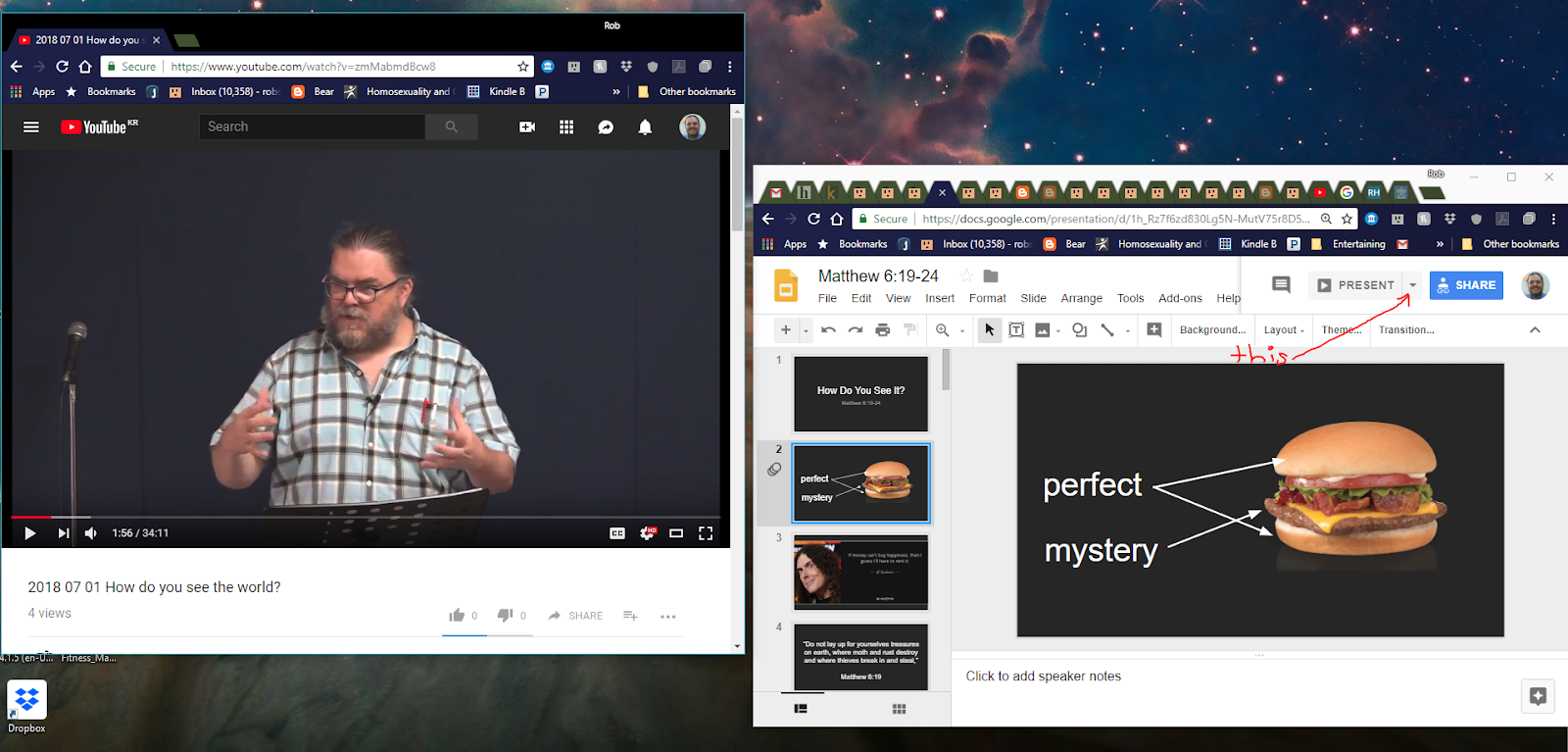
Before you watch the video, I have to warn you. There was a slideshow with it. You can't see the slides in the video at all, but if you want to, you can watch along. It's a little complicated, but I have faith in you.
First open the slideshow by clicking on this sentence. It should open in a new window. If it opens in a tab, pull the tab off and give it its own window. I have the YouTube video open in the window on the left, and the slides in the window on the right.
Click the pull-down menu next to "Present." (Sorry, it's not a gift. It's a verb, to present.) Click on "Presenter View." This will open the presentation in that window, and open up another window. In the picture below, you can see this window in the middle of the screen. I've already gone on to slide #2: the burger slide. Mmmm, burger.
Minimize that preview window, or exit it. Shouldn't matter which. Then you can click on the presentation screen to advance the slides in time with the sermon. In the bottom left, if you mouse over it, there is a section of left and right arrows and other stuff. You can use those to go forward or backward in the presentation. Your keyboard arrows might work as well, but not if you have clicked on the video in the mean time.
For fun, you might see if you can do better than Rachel. It was her first time, and she was in front of a live congregation. There are (and were) no cues in the manuscript, so I was letting her know to advance the slides by waving my arms in a subtle fashion. We make a pretty good team. (Hi Rachel!) If you get lost in the slides, you will probably be fine just listening. Most of them are just the Bible verses I am reading or referring to, but I've got a few fun surprises in there besides the hamburger. My last few sermons have been kind of heavy, so I lightened this one up a bit.
Wasn't that nice?
Here is the text of the sermon.
Matthew 6:19-24 19 “Do not lay up for yourselves treasures on earth, where moth and rust destroy and where thieves break in and steal, 20 but lay up for yourselves treasures in heaven, where neither moth nor rust destroys and where thieves do not break in and steal. 21 For where your treasure is, there your heart will be also. 22 “The eye is the lamp of the body. So, if your eye is healthy, your whole body will be full of light, 23 but if your eye is bad, your whole body will be full of darkness. If then the light in you is darkness, how great is the darkness! 24 “No one can serve two masters, for either he will hate the one and love the other, or he will be devoted to the one and despise the other. You cannot serve God and money.”
Imagine that you walk into a restaurant and order a hamburger. The waiter brings you a beautiful burger, freshly cooked, and smelling wonderful. You take a bite, chew, and start to wonder what exactly is in this burger? The bread is the perfect mix of sturdy yet biteable, and tastes perfect. But you are not sure what is in the meat patty: it’s like nothing you’ve ever had before. You think it tastes good, but you wonder what it is made of. You decide that you can’t really be satisfied with your meal until you know.
Our scripture today is kind of like that hamburger. One in which the bread, the beginning and ending, is easily understood, but the meat in the middle is… mystery meat. If it is meat at all. Maybe it’s made of lentils and mushrooms? Tasty, but unknown, hard to understand.
I’ve heard and read this scripture uncountable times in my life without really thinking about it. The fact is, I did not understand it until I did some research a couple of weeks ago.
The first and last ideas in today’s passage are very basic to being a citizen of the Kingdom of Heaven. I’m going to hit their main points quickly, then get a little bit into the weeds on the idea of Heaven itself. So let’s start with the bread on top:
“Do not lay up for yourselves treasures on earth, where moth and rust destroy and where thieves break in and steal,” Matthew 6:19 Weird Al Yankovic is one of my long time favorite singer/songwriters. He has a lyric in a song about being rich: “If money can’t buy happiness, I guess I’ll have to rent it.” Because money can make us happy, but it’s always short-term. [The song is called, "This Is The Life." I didn't include any more of it in the sermon. Sorry, Penny.]
It’s natural to gravitate towards a bigger home, a newer car, and meals in fine restaurants. Pop culture tells us that those things make us happy. I know that when I get a new phone, or t.v. or even something as simple as a new pen, it cheers me up. But not for long. You know this.
Those treasures are simple: we can measure them, and see them, and tell our coworkers about them without looking weird. Then Jesus says,
“but lay up for yourselves treasures in heaven, where neither moth nor rust destroys and where thieves do not break in and steal.” Matthew 6:20 Fine. Treasures in heaven. And how do we do that? Jesus has been discussing it for this whole chapter, in three ways we’ve covered here the past three weeks. First:
But when you give to the needy, do not let your left hand know what your right hand is doing, so that your giving may be in secret. And your Father who sees in secret will reward you. Matthew 6:3-4
So, giving to the poor. Next:
But when you pray, go into your room and shut the door and pray to your Father who is in secret. And your Father who sees in secret will reward you. Matthew 6:6 So praying. And last:
But when you fast, anoint your head and wash your face, that your fasting may not be seen by others but by your Father who is in secret. And your Father who sees in secret will reward you. Matthew 6:17-18 So, fasting.
None of this for others to see, but as a personal act of gratitude to God, and a desire to love like God loves. I’m not going to go into detail on these, because you have already sat through three sermons about them, and you can watch them on YouTube if you want to review.
For where your treasure is, there your heart will be also. Matthew 6:21 Now this is a little tricky, and I’m going to spend some time talking about the reward storage area.
What does it mean to have treasure in heaven? Treasure from giving to others, from praying, and from fasting in secret? When I put money in the bank, I can take money back out. If I put jewelry in a safe deposit box, I know that when I come back later the exact same jewelry will be there. A treasure is a treasure because it is valuable to you. So what kind of treasure have you stored by praying, fasting, and giving your things away?
In the coming weeks we will hear about how God provides for our physical needs, and how we will bear fruit, but we can also go back to the beginning of the Sermon on the Mount to define this treasure. The Beatitudes tell us that we will be blessed, or happy. And they also promise this:
Blessed are the poor in spirit, for theirs is the kingdom of heaven. Blessed are those who are persecuted for righteousness' sake, for theirs is the kingdom of heaven.Matthew 5:3, 10 There is a danger lurking at the edges of today’s passage. A danger that prowls around any talk of Heaven. Joshua warned us about it two weeks ago. The danger is that we can so easily get the sense that Heaven is something we will not experience until either we die, or Jesus comes again. But listen to Jesus:
Now after John was arrested, Jesus came into Galilee, proclaiming the gospel of God, and saying, “The time is fulfilled, and the kingdom of God is at hand; repent and believe in the gospel.” Mark 1:14-15
“At hand” means super close. As in, one crucifixion and resurrection away. And in Luke Jesus says this:
“The kingdom of God is not coming in ways that can be observed, nor will they say, ‘Look, here it is!’ or ‘There!’ for behold, the Kingdom of God is in the midst of you.” Luke 17:20b-21 The Kingdom of Heaven is not just something waiting for you after you die. Heaven is God’s Kingdom breaking into our right now, today. God’s grace and peace, God’s hope and love, spilling out into the world. And guess who it is spilling through? That's right, you. I hope us, but even more I hope you.
Let’s move on to the bottom bun. This one is very simple: “No one can serve two masters, for either he will hate the one and love the other, or he will be devoted to the one and despise the other. You cannot serve God and money.” Matthew 6:24 This does not mean that you can’t do more than one thing. You can have hobbies and friends and family while God is your master. But you can’t let something else take the place of God.
The word used for money in this verse is “mammon.” It means money as an idol, or even as a god. There is an element of personification in the word mammon, as though it were a thinking, planning master. Think “money,” but with Darth Vader’s music in the background.
We need to be careful not to dismiss other obsessions as being safe. If your book collection becomes the center of your life, it is your mammon. The same can go for friends, or work, or fame, or pride. But our scripture today is clearly focused on money.
Now let’s get to the meat of this burger.
“The eye is the lamp of the body. So, if your eye is healthy, your whole body will be full of light, but if your eye is bad, your whole body will be full of darkness. If then the light in you is darkness, how great is the darkness! Matthew 6:22-23
Metaphor is hard enough to deal with in the Bible. This is not even a metaphor, as far as I can tell from my research. A metaphor is a way of comparing things that are different. But people in Biblical times may have thought of this as literal truth.
It is impossible for us to understand what Jesus is telling us in verses 22 and 23 if we don’t understand how people in Jesus’ time thought about the eye.
Most of us today consider the eye to be like a little window. We might even imagine our brain being like a little person inside our head, looking out. In some ways, this isn’t a bad model, but it doesn't apply here. It was more than a thousand years after Jesus died that glass windows like the ones in this building were widely used. Once people were familiar with glass windows, the similarity to the eye became obvious, and the eye-as-window became a popular idea. Jesus’ audience would not have thought that way at all.
Before glass was widely available, windows were either holes in the wall with shutters, or some translucent material, like paper or thin stone, letting in nothing more than functional light.
So at that time, the general understanding of the eye had to do with illumination: light. It was obvious that you needed a source of light to see things, and it was assumed that the eye itself was a source of light. A lamp, if you will. So when Jesus says, “The eye is the lamp of the body,” his audience there on the mountain got it. They had heard it before. This was common knowledge.
We don’t get it at that level. We can’t. For us to truly understand what Jesus is saying, at a gut level, we have to set aside our current scientific understanding of the physics and biology involved with our eyes. We can’t think lenses, and rods, and cones, and optic nerves. We have to set aside our rational selves, suspend our disbelief. The same way you watch a superhero movie, or read a book with witches and wizards.
You have to believe that your eyes are a source of light.
Let’s talk about light. We know, without even thinking about it, that the quality and quantity of light changes the way we see things.
Sunshine makes colors snap. You can see details, and people look healthy and vibrant. [You can't miss this slide. It is the sun in a slightly cloudy sky. Now you are caught up!]
Fluorescent lights mute some colors. It make people look sick and tired. It emphasizes the wrinkles and blemishes, makes the healthiest complexion seem pale and weak.
One of my favorite kinds of light is a campfire on a warm summer night. People facing the fire take on the life of the dancing flames, or the warm glow of the embers, while their backs are hidden in shadow.
Maybe you enjoy going to clubs, and part of that is the strobe lights, the colored lights, flashing, spinning, giving a frenetic energy to people on the dance floor. It is not my scene, but I understand the appeal.
Let’s take another look at verse 22:
“The eye is the lamp of the body. So, if your eye is healthy, your whole body will be full of light,” Matthew 6:22
The word “healthy” has been translated in a few different ways. The King James Version uses the word “single,” suggesting that some readers may have been pirates. I’ve also seen “sincere,” “good,” and “simple.” But apparently the Greek word here can also be translated as “undivided.”
“So if your eye is undivided…” is an idiom that suggests recognizing the difference between good and evil. There is also a suggestion of “integrity” or “simplicity.” It is very likely a clever bit of wordplay that carries multiple meanings. The exact sort of thing that makes translation so difficult.
My wife's name, like many Korean given names, is made of two Chinese characters. The second syllable, ryon, means "water lily," a simple noun. The first syllable, "Ho," is simply translated as "beautiful," but it is a complicated sort of beautiful. It means well-balanced, or harmonious, and therefore beautiful.
Your light changes the way you see. The way you see changes what you do. And what you do changes who you are.
What it comes down to is your focus. As we read earlier, you can’t focus on both money and God.
“but if your eye is bad, your whole body will be full of darkness. If then the light in you is darkness, how great is the darkness!” Matthew 6:22-23
This means focusing on money. When you focus only on things, you value humans less and less. When you say, “This is mine, and I will not share!” you are denying your own image of God.
When you decide that some people are no more than animals and pests, you are seeing only the darkness in the world, and missing out on the version that in the beginning God created.
When you kidnap children from their families because that will keep other families from coming to your door to ask for help, you are projecting the darkness in you onto the world. How great is the darkness!
But I want to come back to this:
So, if your eye is undivided, your whole body will be full of light,” Matthew 6:22b
The undivided eye values people. The healthy eye loves people, even our enemies. Especially our enemies! The simple eye sees the Kingdom of Heaven all around, and wants to help build it up even more!
The healthy, undivided eye invites God into the body, because it sees God everywhere! And when God comes in, the whole body is full of light!
So now we can assemble our burger. Does everyone feel okay with the eye being the lamp of the body? Good. Now we can start with choosing our treasure carefully, add the eye lamp, and finish with choosing our god carefully.
We know that we want to choose heavenly treasures, but how exactly do we do that?
Let’s take a quick look back at the scriptures we’ve studies the past three weeks:
But when you give to the needy, do not let your left hand know what your right hand is doing, so that your giving may be in secret. And your Father who sees in secret will reward you.Matthew 6:3-4 But when you pray, go into your room and shut the door and pray to your Father who is in secret. And your Father who sees in secret will reward you.Matthew 6:6 But when you fast, anoint your head and wash your face, that your fasting may not be seen by others but by your Father who is in secret. And your Father who sees in secret will reward you.Matthew 6:21
What exactly is this reward? On the surface, it sounds almost like payment for doing work that God has assigned to us, but we know that grace is a gift from God. We know that we can’t earn our salvation, or any of these rewards that Jesus is telling us about.
What is a good reward, anyway? For a prize, I want to have something valuable! Something I can treasure! I’ll give you a clue: David knew. Do you remember this verse? One thing have I asked of the Lord, that will I seek after: that I may dwell in the house of the Lord all the days of my life, to gaze upon the beauty of the Lord and to inquire in his temple. Psalm 27:4
There is the vision again, gazing upon the beauty of the Lord. If you have an undivided, healthy eye, you will be seeing the house of the Lord, God’s Kingdom. And the Kingdom of God has no sun; it reflects God’s glory.
In this case, seeking is finding. Seeing is having.
When the lamp of our body shines out into the world in a healthy way, it reveals the original, unspoiled creation! Under the brokenness, the refuse, the junk and crud and mess that humans and sin have made of it and themselves, there is still something beautiful. Way back when, God saw the creation and said, “It is good,” and the darkness has not overcome it. Just as we have been washed clean in the blood of Jesus, the rest of the world is waiting, wanting to be cleansed, restored, redeemed.
In conclusion, if your definition of treasure is all wrong, it is causing you problems. If you are putting your time and energy into things you can hold, and bank accounts you can measure, your are setting yourself up for failure. Because in the end, all of that treasure will be lost, or stolen, or just fall apart.
You need to invest your blood, sweat and tears in love, not just love for your family and friends, but love for your neighbors, love for your enemies, love for those who are out to get you. You have to listen to them, and love them, and forgive them, because that is a treasure that will last. That is a treasure that no one can take away. That is the investment that will always return more than you put in to it.
When you see the world the right way, God’s way, the very seeing fills you up, makes you more truly a part of God’s creation, of God’s kingdom. But when you look at the world and see only what you can take, only what you can use, only what you can dominate, you fill yourself with emptiness, with darkness.
No one can serve two masters. Whatever you have decided is your treasure, that is also your master. Because we acknowledge a master by showing loyalty and devotion. The biggest measure of your loyalty will be your time, but also your money, your energy, even your thoughts and emotions. If someone were to look at your internet browser history, they might have some idea of who your master is.
You have to make up your mind about what is important to you: will it be God and love, or money and stuff? You can’t pursue both. They are like North and South: the further North you get, the farther you are from the South pole, and vice versa. Except with God and Money, the closer you to get to the one, the more you will hate the other. The more you pursue money, the less you will love God, and the more you pursue God, the less you will love money. You can’t love both. And if you try, you will end up hating one. Guess which one the world wants you to hate?
We can fix poor eyesight with glasses and contacts. We can shift the colors of the physical world with sunglasses. But only God can change the way we truly see the world. Jesus told us:
You are the light of the world. Matthew 5:14a
Jesus is calling you to shine. Call on God to give you true sight.
I saw a travelling Broadway cast production of "Into The Woods" when I was in university, and loved it immediately. I saw it with K, my only girlfriend in university, but my affection for the show escaped that breakup unscathed. The Broadway show recording was one of my first 100 CDs, also a gift from K, and I remember seeing a PBS video of the Broadway show.
Somehow the 2014 movie version slipped under my radar. Stressful couple of years. And then it popped up on Netflix. I showed the first song to Maxine on Friday night.
1 She begged to watch a little bit more, and since it was Friday, I said yes. Soon Quinten joined us, and we ended up watching the first hour and a quarter of this two-hour movie.
2
That put them to bed after 11:30, but again, it was Friday night. One of my favorite childhood memories was being allowed to stay up late when something cool was on t.v. And they still whined about not being able to watch the last 45 minutes, so I got to be the terrible daddy, one of my favorite roles.
The next day we watched the rest of the movie, and Maxine asked to have the soundtrack on her USB drive.
3 So I dug through my files, but I couldn't find it.
This was frustrating, as I'm sure I've listened to that music sometime in the past 18 years. I know the CD is in a box in my parents' basement, and I know I listened to that CD many times, but I'm also sure that I ripped it at one point and had it on my computer. How could I not have done so?
So there is a memory gap. I'm not sure whether it is a gap in mine or that of the computer.
I started ripping my music into MP3s in the early 2000s. I had no idea what I was doing, and made some of them at very low sampling rates, like 56 kbps. (Sorry, that means that it sounded like a song your record off the radio from a station that isn't coming in very clearly. Not with static exactly, but not nearly as good as it could be.) I was mostly concerned with storage space, since I had hundreds of CDs and digital memory was just pulling into the burnable CD stage.
Once I figured out my mistake, I immediately sifted through the thousands of songs I had ripped and deleted the ones with low bitrates. I then ripped their respective CDs again at very high bitrates, anticipating a time when computer drives and external memory would be large and cheap.
Just kidding. I did nothing. I didn't even realize the mistake until years later, when I started listening on higher quality speakers and headphones, and wanted to carry around thousands of songs on my phone. But fixing that mistake would have taken time and effort, and I am nothing if not lazy.
I have steadily added to that collection of digital music over the years, but there has also been a trickle of songs disappearing
4, sometimes entire albums. One of the first I noticed was from "Pictures at an Exhibition," a gorgeous tone poem tour of an art museum. It has four tracks labeled "Promenade" (which I believe represent walking through the museum, little interludes between the drama of the paintings). But my computer at some point didn't like the idea of having multiple tracks with the same name. It most likely asked me what to do about it, and I told it to not bother copying tracks with the same name, because that would take up space.
Another space-saving habit I had was not keeping copies of tracks that appeared on other albums. So I have many "Best of" and "Greatest Hits" albums with little gaps where I thought I would save 67 megabytes and avoid hearing the same song too often on random play. To be fair, that's about 1.5% of a CD rom, so it would have made room for a few more songs. But I ended up with incomplete albums, and if I had listened to the original CDs enough, I noticed those gaps.
Once I figured out that mistake, I immediately made copies of the missing songs, changed their i.d. tags, and made my collection more complete.
Just kidding again. I did nothing. Because it would take time and effort, and I'm lazy, and it was a minor annoyance.
I have found entire albums
5 missing. One I found recently that I had on my phone, but not my computer. Of course, as soon as I figured that out I copied it from my phone to my...
Yeah, kidding again. I did nothing. I'm not even sure what album it was.
So here is my plan: the next time I am visiting America, I will sit down with the four thousand or so CDs in my parents basement and start ripping them into FLAC files. This is a lossless format that is supposed to sound exactly the same as what is on the CD, and takes up a correspondingly large amount of space. But you can buy external drives that are measured in terabytes, so this is actually doable.
Just kidding. I'm not going to do that! I will be in America! The last thing I want to do is park in front of a computer for hours at a time!
6
So maybe "Into The Woods" followed the missing album path that has been traversed by so many albums before it.
Unless it didn't.
I am now wondering if maybe ITW did not escape my college romance breakup completely unscathed. I am wondering if maybe I never listened to it again starting the semester I spent listening to sad music and not doing homework in reaction to being dumped by the first girl I had ever fallen in love with.
7
It is a distasteful memory that I don't like replaying for myself, much less for you, but it's been 18 years. It's time to look back.
As I was watching the movie with my kids, and listening to the music again over the next few days, it felt familiar, but I couldn't sing along with more than a line or two from any song. And if you know Sondheim, you know how easy it is to sing along. Quinten has been singing a few lines over the past couple of weeks, and he heard it only once!
For me, the music is coming back, but not like songs that I once knew by heart. The Wolf's song, "Hello, Little Girl," is very memorable. The rhymes are delicious, and the double entendre/innuendo is enough to make me a bit uncomfortable in front of my kids, but not obvious enough to make me turn it off. In other words, perfect for 20-year-old me through 35-year-old me. I should have listened to this song, and the rest of the album, enough times to have big portions of it down pat.
Did I dump this album after I got dumped? Did I leave it in a box in America and pretend it never existed because of the negative associations with the K breakup?
Honestly, I don't know. I was journaling a little back then, but it would never have gotten to that level of detail. I probably wouldn't have mentioned anything to do with being dumped other than how much it sucked. I can't even check because those journals are sitting in a box next to the boxes of CDs in my parents' basement.
I am considering having them all digitized, though. It will take me a while to get through them and redact them for publication on the Roblog, but it shouldn't take more than...
You got me. I'm never going to do that.
One of my favorite podcasts is Revisionist History, by Malcolm Gladwell, author of Outliers, The Tipping Point, and others. I recently listened to an episode called "A Polite Word for Liar (Memory Part 1)" (You can listen to it at that link, which I highly recommend.) He presented some very convincing evidence to show that memory is extremely unreliable, even when we do our best to be objective. To put it simply, the brain is made of subjective, coated with a thin layer of trying-to-be-objective.
And it occurs to me that I could have very deliberately dropped ITW from my playlists, and forgotten doing it.
But there is no way of finding out for sure. If I try to think objectively about it, as an outsider would, I very much prefer the story of dropping ITW like K dropped me. It feels like a real, feelings-based decision that you would expect from someone experiencing a serious break-up for the first time.
It makes me wonder if most of my decisions in life were not actually rational, or even somewhat thought out, but just justified later by filling in the blanks with a story that appealed to me at the time. Is my life more fiction than non-fiction?
I think I'm okay with it, even if the answer is yes. What choice do I have, but to write about what I'm going through? I want to believe that my thoughts on a decision one day later are more accurate than 18 years later. But are they really?
How well do you think you remember things? I don't know any more. My plan is to let yesterday worry about itself, along with tomorrow. I've got enough to worry about today.
1 *It's an epic intro, 15 minutes of beautifully intertwined parts introducing Cinderella and her step mother and sisters, Jack and his mother and their dried up cow, the childless baker and his wife and the witch who cursed his father, and Red Riding Hood. The song also starts some of the characters on their plot arcs, which will eventually intersect in the woods, of course.↩ 2 The original show is about 20 minutes longer, with one of my favorite songs cut, the reprise of "Agony" in which the two handsome princes sing about how they've each found another beautiful damsel in distress, but guess it's time to go back home to their wives.↩ 3 She has a small boombox with CD player, a USB slot, and a 16 GB drive the size of my thumbnail. I load it up with songs she likes from my collection, songs ripped from her CDs, and songs Horyon downloads for her. There is no convenient way to navigate the collection on the drive, even though the songs are mostly in folders, but compared to the single-speaker cassette player I started with, it is the bomb. I think I might give her an MP3 player next Christmas. Time to up the music game.↩ 4 I know, the word "disappear" suggests mystery, and that was clearly my fault. But I feel better saying disappear, and you are not writing this, so shut it.↩ 5 An album is a collection of songs that belong together. The name comes from a disc made of vinyl with a groove cut into it. Minor irregularities in the groove would be converted into soundwaves by a needle, and amplified by a stereo system. Hence the terms "groovy" and "disc jockey" a.k.a. D.J. Now you know, and knowing is half the battle.↩ 6 Of course, I will park in front of a computer for hours at a time, but that will be for fun stuff.↩ 7 My high school girlfriend and I really liked each other, and we are still friends (Hi J!), but we were not that deeply in love.↩
For what it's worth, I've done some revising to the manuscript here, in some cases aiming toward what I delivered in church, in some cases making it more broadly relevant.
Matthew 5:43-48Redeemer ICC Love Your EnemyJune 3rd, 2018
You have heard that it was said, “You shall love your neighbor and hate your enemy.” But I say to you, love your enemy and pray for those who persecute you, so that you may be sons of your father who is in heaven. For he makes his sun rise on the evil and on the good, and sends rain on the just and on the unjust. For if you love those who love you, what reward to you have? Do not even the tax collectors do the same? And if you greet only your brothers, what more are you doing than others? Do not even the gentiles do the same? You therefore must be perfect, as your heavenly father is perfect. Matthew 5:43-48
Wow. Love your enemies? It’s so hard, so contrary to our nature. Loving our enemies, and praying for those who persecute us. And let’s face it: how many of us really have enemies? Please raise your hand if someone has literally tried to kill you in the past month. Not including times you thought you were going to be hit by a car. Lousy drivers don’t count as enemies, otherwise Busan would be full of enemies. And yet when people come into our lives who do not treat us as we want to be treated, we decide that they are our enemies.
Recently I found that I had an enemy at work. He was insulting. He was new at my workplace, but acted like he knew better than I how to do my job. He sent me messages that had the tone of a boss talking to the guy who brings coffee. I’m pretty easy going, but he pushed all the right buttons, and I snapped at him in a message exchange.
When I talk with my coworkers about him, they tell me not to bother apologizing. “With a guy like this, it’s just permission to be more of a jerk.” I nod. “That makes sense,” I say.
Fortunately, I have been meditating on today’s scripture for the past six weeks, so I knew that I had to pray for him. And I did. I'm afraid the first few prayers sounded like this:
“Dear God, please put you-know-who in his place. And if you don’t mind, make that place far from here. Amen.” There. That should do it.
No, something’s wrong. Let me try again. “Dear God, I am praying for my enemy. Help me to love him. Help me to understand him. Help me to stop him from acting like a jerk! Help me to…” Wait a minute. I’m not really praying for him, am I. I’m praying for myself! Dangit!
Why is it so hard to just say, “God, please give peace to him”? Why is it so hard to say, “God, forgive him”?
When I pray for myself, it’s easy! “God, give me what I need, not what I deserve!” Why am I so quick to turn it around for him? “God, give him what he deserves, not what he needs!”
Let me check the instructions again.
“You have heard it said, ‘Love your neighbor and hate your enemy.’ But I say to you, love your enemy and pray for those who persecute you,” Matthew 5:43-44
Yeah. Looks like I’m getting something wrong. Maybe we can figure it out later.
But for now, I want to point out a pattern: This is the sixth time in the Sermon on the Mount that Jesus has said, “You have heard something-something,” followed by “but I tell you something-something different.” The first few were almost direct quotes, but Joshua pointed out to us that “You shall not swear falsely…” is sort of gathered from many places in the Torah--the Old Testament. But in verse 43, things get kind of strange.
Here are some questions that might help you figure out how it is strange. To see the answers, highlight the space after "Answer:" to reveal... you know.
1. True or false, the Bible says: “You shall do no injustice in court.”
Answer: True! Leviticus 19:15
2. True or false, the Bible says: “God helps those who help themselves.”
Answer: False! But it does say that in Aesop’s fables, sort of. It actually reads, “The gods help those who help themselves.” So if you have said this, congratulations! You might just be a polytheist!
3. True or false, the Bible says: “Hate the sin, love the sinner.”
Answer: False. But Ghandi said it, so if you guessed true, you might just be a Hindu! To be fair, though, there are roots of this in Jude 1:22-23 “And have mercy on those who doubt; save others by snatching them out of the fire; to others show mercy with fear, hating even the garment stained by the flesh.” So a “garment stained by the flesh” is the sin, I suppose. Forget it, you're not getting a point for this one.
4. True or false, the Bible says: “Money is the root of all evil.”
Answer: False. “The love of money is the root of all evil.” 1 Tim 6:10. Isn't it just like humans to shift the blame from ourselves to a thing? Next best thing to idolatry!
5. True or false, the Bible says: “We three kings of Orient are, bearing gifts we traverse afar.”
Answer: False again. That’s an Epiphany hymn, one you should sing after Christmas. But it does come from a Bible story, and it’s essentially true. I guess I’ll give you the point if you said true.
6. True or false, the Bible says: “You shall love your neighbor and hate your enemy.”
Answer: Of course it’s really in the Bible! We just read it here in Matthew! But can you find it anywhere else?
“Love your neighbor” is all over the place, Old Testament and New. But “hate your enemy” only pops up here in Matthew, where Jesus says we’ve heard it before. I take that to mean that we today still do.
Let's check out the Ten Commandments. Any hate in there? Nope. How about the rest of the commandments given to Israel by God through Moses, all 613. Care to guess how many of them instruct us to hate anyone? If you guessed zero, you are correct.
So “hate your enemy” isn’t in the Torah, or the Prophets, or any of the other Jewish writings of the period. What Jesus and his followers would have called their Bible and study guides. So why does Jesus bring it up in this context?
I am guessing that there are two reasons, one wrong and one right.
First, this “hate your enemies” attitude was, and still is, quite popular in the world. Just look at all the places where people are shooting at each other. Just look at all the ways we put up walls to separate “us” from “them.” Just look at what American politics has become.
So yes, the world can be a hateful place, and that makes us sad, and we look out from our church here and say, “How pitiful it is to be one of them. They have it pretty bad out there.”
Yeah. I think that's the wrong reason. I think you will agree with me when we look back again at our previous five Sermon on the Mount sermons. Jesus has set a pattern in which the religious traditions of the time are compared to God’s intentions:
The 10 Commandments say, “Do not murder,” but Jesus tells us, “Murder starts with anger in your heart!”
They also say, “Do not commit adultery,” but Jesus tells us, “Adultery starts with lust in your heart!”
Moses says, “If you get divorced, do it right,” but Jesus tells us, “Marriage is sacred to God!”
The Torah says, “Do not swear falsely,” but Jesus tells us, “Let your words carry nothing but truth!”
The sacred law says, “An eye for an eye, and a tooth for a tooth,” but Jesus tells us, “Be humble, non-confrontational, and wise!”
Now Jesus tells us, “Love and pray for your enemies,” but where do we find “Hate your enemy,” if it’s not in the Bible?
The right reason Jesus is bringing up “Hate your enemies” is that we find it in the church, now as then. It has worked its way in, the same way the smell from our bathroom here sometimes seeps into our place of worship.
Some of you listening to this message will know exactly what I am talking about. Someone in the church has decided that you were the enemy, and acted accordingly. You got hurt. Maybe you are still hurting. Maybe you are listening to me on YouTube rather than being here because you were hurt so bad that you couldn’t bring yourself to turn the other cheek again.
And maybe you know what I am talking about because you have decided that a brother or sister in the church was your enemy. You let your anger grow. You talked behind their back. You hated them, just like you heard it was said. You secretly believed that the church would be better off without so-and-so.
Brothers and sisters, we were made to be better than that. We were called to be better than that. We are called to love our enemies
so that you may be sons of your father who is in heaven. For he makes his sun rise on the evil and on the good, and sends rain on the just and on the unjust. Matthew 5:4-5
Anyone who has prayed with me more than once has heard me refer to God's blessings falling on us like rain. Remember that Jesus and the people he taught lived in a desert. Water was a scarce commodity, usually found in wells and oases. Rain was the gift of life, bringing hope to everyone. Refreshing everyone. Soothing everyone, good and evil. Just and unjust.
People also give life, hope and refreshment to others around them. And not just us Christians, either. Everyone loves someone at some point. Jesus makes that clear when he says,
For if you love those who love you, what reward to you have? Do not even the tax collectors do the same? And if you greet only your brothers, what more are you doing than others? Do not even the gentiles do the same? Matthew 5:46-47
Jesus is saying that everyone loves. Even those nasty, money-grabbing tax collectors. Even the gentiles, who don’t even believe in God. Even the academy owners. Even they love. The ability to love is part of being created in God’s image, and it is part of EVERYONE.
If you love your parents, that’s fine. If you love your friends, that’s natural. But that love is intended to be a starting point, a model for how God loves us so that we can go beyond the easy love.
We are called to love our enemies, and pray for those who persecute us,
so that you may be sons of your father who is in heaven. Matthew 5:4
Children are such blessings, but ask any parent and they will tell you: children are little mirrors, doing what they see their parents do. If you are consistently polite, they will be consistently polite. If you say nice things about other people, they will too. If you give generously of your time and money, they will also let go of these things easily.
We are children of God. Part of loving God means copying God.
...but God shows his love for us in that while we were still sinners, Christ died for us. Romans 5:8
We were God’s enemies. Loving your enemies means that you can’t keep thinking of them as your enemies. You have to forgive. You have to let go of the the need for revenge, the part of you that demands justice. You have to be like God. Not because God is commanding you, but because when you look at God you think, “That is the best way to be. I want to be like that.”
So I forgave my coworker. I forgave him, and I kept praying for him.
At first my prayers keep shifting, like walking on a sliding dune, and I found myself telling God about all the ways that this guy had offended me. But I got better at it, and my prayers became more true, more loving. Earlier in the Sermon on the Mount, Jesus told us,
Blessed are the merciful, for they shall receive mercy, Matthew 5:7
How true it is. That even giving this seemingly minor mercy, which my coworker wasn’t aware of, brought mercy to my soul. Because holding onto that judgment was like carrying around a brick; it didn’t stop me from doing anything, but it slowed down everything, and made my life more difficult. When I forgave him, I dropped the brick. My heart became lighter, and my life became easier.
Now my prayers are solid, because mine is the Kingdom of Heaven, even though I don’t deserve it. God gives me the will and the ability to be a citizen of the Kingdom of Heaven, even though I can’t do either on my own.
Mine is the Kingdom of Heaven, and as such I am working at loving my enemy. This means that I have to do something different than I was doing before. I can’t just ask God for love then sit back and wait for it to strike me like an arrow from a flying baby.
And let’s be perfectly clear: Loving my enemies does not earn me this citizenship. Loving my enemies is what I do in response to my citizenship.
I still haven’t apologized for my unkind words, but I have prayed for this guy. Daily. Multiple times on some days. I’ve prayed for him to be blessed, to be happy. I’ve prayed for the pain that is in his heart to be lessened. And of course I have still prayed for myself to have patience, but also for me to love him.
Now when we talk it feels different. I compliment his work, and decide to not be offended when his words feel like attacks. It is still difficult, but it stopped feeling like a chore assigned to me by God. The more I pray for him, and practice kindness towards him, the easier both become.
Now when my coworkers talk about him, I defend him. I remind them of his strengths, and suggest that he is misunderstood. And I may be getting some side-eye, and even a little push back. But I don’t mind. It's worth the price.
Jesus is asking us to be seriously counter culture. Not counter-American culture, or counter-Korean culture, or counter-Gabonese, counter-British, counter-Indonesian, counter-Chinese, or counter-South African. Jesus is not just counter to our culture, Jesus is counter to World culture! Jesus is counter to your culture! The Psalmist tells us
The stone that the builders rejected has become the cornerstone. Psalm 118:22
If we are building off of Jesus, the world will reject us along with him. The world-culture that Jesus is calling us to rebel against is not just a product of the media, or science, or liberal education. It’s not our politics or history or system of government. Our culture has been set against the culture of the Kingdom of God since The Fall.
And here Jesus is calling us to love our enemies, to pray for the people who persecute us! It goes against our nature! It flies in the face of every culture!
Remember, Jesus also tells us that the first shall be last, and the last shall be first. He isn’t just talking about the line for lunch, or getting the next iPhone, or seeing Jurassic World 2. Jesus is calling us to surrender. Surrender the opportunity to attack first. Surrender the advantage of position. Surrender the need to appear better than someone else. Surrender being right.
But here’s the big secret: forgiving your enemies may be good for them, but it is even better for you. Because what does surrender mean? It means giving up.
Giving up what? Yourself.
Then Jesus said to his disciples, “Whoever wants to be my disciple must deny themselves and take up their cross and follow me. For whoever wants to save their life will lose it, but whoever loses their life for me will find it.” Matthew 16:24-25
Maybe you’ve heard that a thousand times, or maybe it’s a new one for you, but it is a profound, deep truth that Jesus preaches over and over, until he demonstrates it at the cross.
Every week we come in here and sing and pray and talk about giving ourselves up to God, and we’re happy with that. We are happy because we imagine that denying ourselves means coming to church Sunday mornings. Reading our Bible and praying. Maybe serving in some church ministry.
But this talk of loving enemies is real surrender, even more than loving your neighbor as yourself.
For application this week, I invite you to let God get up in your face. Maybe you think you don’t have any enemies just because you don’t use the word “enemy.” Honestly, i hope you’re right. I hope that you have eliminated the idea of an enemy from your mind. But just in case:
1. Memorize this bit: “But I say to you, love your enemy and pray for those who persecute you,” Matthew 5:44
2. Consider your enemies. Think about the people who annoy you. Inconvenience you. Look down on you.
3. Pray for them.
4. Lovingly.
5. Let it show in your actions towards them.
6. Lean on God for the strength and will to do so.
A message pops up from an old friend from my Peace Corps days:
"Rob, Say a prayer for Eric today. He passed last night. All are in shock. Unexpected. Think it was the heart."
Eric and I spent almost no time together in Nepal. I think I can count the conversations we had on both hands, likely leaving enough fingers for a double Bronx salute. We were in the same Peace Corps cohort in Nepal, which lasted for just over two years. Eric stayed on for a third, married a Nepali woman, and later moved back to Rhode Island.
One of my last conversations with him in Nepal involved me implying that he was signing on for another year of hell while the rest of us were escaping. Which is pretty much how I felt at the time.
This is the point in the story where I am supposed to tell you that I never apologized, and now it's too late, and I regret leaving things the way they were. I am then supposed to go on to tell you to reach out to someone before it's too late, apologize, and make the best of the time you have left.
That's not my story. Not this time, anyway.
In 2008, almost 10 years after leaving Nepal, we got sort of bumped back together on Facebook. When I look back on our official Facebook history, there are seven posts. That's it. Less than one per year, and all him posting on my timeline, because I kind of suck at Facebook. What it doesn't show is the numerous times he and I hijacked someone else's post with the kind of conversations that are usually reserved for the wee hours of the morning when both parties are short on sleep but long on words.
But the real evidence of how our relationship changed is in Messenger. There are conversations about movies based on comic books, of course. But there are a couple of very serious conversations as well, including one in which we both apologize for how we treated each other back in the day. It's not a lengthy apology on either end, but it is warm, and real, and proof that sometimes the internet improves relationships rather than merely attaching bells and whistles and a light coating of fecal matter. I'm grateful for the record, and sad that we had not added more to it.
He died from a heart attack. Went home feeling sick on Friday, Saturday night his heart gave up. He was so full of energy and life. The kind of energy that says, "One more year of mountain hiking to get anywhere, occasional parasites and food poisoning, and dirt-road slalom busses? Count me in!"
All of my photos from Nepal are boxed up in my parents' basement, but I'm pretty sure there are none of just Eric and me. We didn't do much together outside of larger groups. In the past ten years I figured that on one of our trips to the States we would get to Rhode Island and get that picture. Our wives could compare notes, our daughters could hang out, and I would get to see his "Pow Science!" store.
I got the message at about one a.m. Horyon was working and the kids were in bed. Horyon heard my sobs of grief and was sure that a relative had died. She was relieved to find it was someone she had never met.
And never will.
So mend relationships when you are able. Get together while you still can.
Here's a link to the sermon itself on YouTube. The full text is below.
This was a tough one, as the video title suggests. The preaching team at our church is four men. Joe suggested a series on purity: the definition of purity, purity of speech, sexual purity, and purity of heart. The scheduling of vacations and such dealt me the fun one.
I had almost a month to prepare for this, but it was a month busy with other things. I taught a three week class for my university in the middle of it, starting the day after Christmas, and my kids were on vacation. Those two things alone make for a busy month. For two days of my class, I brought Quinten to campus with me and had a former student take care of him for the two hours I was in class.
(Side note: I offered to pay her $15 per day, so about $7 per hour. She said it was more than enough. When I told me wife, she said I should have made it $30 for one day. I compromised with $20, and told her if she wanted to buy some snack or drink for him it was fine. I think that to my wife, the amount I'm willing to pay for a babysitter reflects how much I value my children. So she values them twice as much as I do, I guess.)
Aside from my schedule, I think that I also put off starting on this one because it's such a sensitive topic. I didn't want to just put out a list of rules, positive or negative, and I definitely wanted to emphasize the power and grace of God that can, and has, worked through so many problems for so many people.
My favorite compliment afterwards was along the lines of, "There was a lot of grace in that message." I can't think of any compliment I'd rather hear. I hope that these words are a blessing to you, and that God's grace is somewhat revealed to you through them.
Rob
Glorify
God In Your Body January 21st, 2018
Flee
from sexual immorality. Every other sin a person commits is outside
the body, but the sexually immoral person sins against his own body.
Or
do you not know that your body is a temple of the Holy Spirit within
you, whom you have from God? You are not your own, for you were
bought with a price. So glorify God in your body. 1 Corinthians 6:18-20
Lord
God, I thank you that your Word and your Spirit are all I need to
bring to your people. I thank you that the Power of your Word and
your Spirit do not come from me, but from you. I thank you that I do
not need to craft my words to change your people, because your Word
and your Spirit alone can break their hearts of stone and give them
hearts of flesh. Amen.
True
or False: The Bible talks about sex a lot.
Granted,
“a lot” is a very subjective term, but I think it does. Probably
more than you think, even if you agree with me that it is a lot. Sex
in the Bible can be tricky to find, but that is a sermon for another
day. For now, I will just say that when you look at the origin
stories of the patriarchs, you find some very interesting situations.
Now,
True or False: Christians talk about sex a lot.
I
think the answer is False. Christians in general don’t talk about
sex, Redeemer International Community Church doesn’t talk about sex
much, and right now many of you are probably wishing that I would
stop saying the word “sex” so much. It just doesn’t feel like
it belongs in church!
I
think this is a big mistake. When we limit ourselves to saying “Wait
until you get married, and don’t commit adultery,” we are
essentially handing the idea of sex over to pop culture.
Shortly
before his arrest and crucifixion, Jesus prays with these words:
I
have given them your word, and the world has hated them because they
are not of the world, just as I am not of the world. I do not ask
that you take them out of the world, but that you keep them from the
evil one. They are not of the world, just as I am not of the world.John
17:14-16
Many
Christians take this to mean that we should back away from the world:
We are not of the world, so we don’t mess with this stuff. But they
are ignoring the words in verse 15 “I do not ask that you take them
out of the world…”
I
refuse to give up this ground. The intersection of faith and sex has
been on my heart and in my prayers for a few weeks now. It is
becoming increasingly uncomfortable to talk about faith at work, and
we can’t seem to talk about sex at church. So where can we talk
about faith and sex at the same time? As usual, my Life Group has
been an invaluable resource. It was a little uncomfortable to start
the conversation, but once we got going, I was glad we did.
My
other source of counsel and inspiration is my children: one of my
jobs as a father is to prepare them to go out into the world, where
they are bombarded by messages that are contrary to God’s will for
our lives. These are a few that I am most worried about:
Your
body only has value if it looks a certain way.
Your
body is a commodity that you can trade for things, such as love,
gifts, career opportunities.
Having
sex with other people is natural, and fun, and it can be risk free.
But
not too much, or you are a slut.
And
not too little, or you are a prude.
Unless
you’re a man. Then you are pressured to be the stud.
Or
ashamed to admit to being a virgin. Though maybe that one pressures
women as well.
Society
is a heartless judgment machine, that quickly incorporates people to
both judge and be judged. It is insidious, and it produces shame. It
tells us that sex is not only natural, but an imperative. It says we
won't be happy without it. It says, “Boys will be boys, and if they
don’t have sex they might just go crazy!” It tells us that a
woman who gets raped by her boyfriend was asking for it. It shows us
pornography, and tells us that this is what sex is: often violent and
degrading to women. People with unrealistic bodies doing unrealistic
things in unrealistic places. And what’s worse, pornography is
often the first way kids learn about sex. At least, when we don’t
step in first.
In
my home, we don’t watch much t.v., and my kids have basically zero
internet access. But they have friends who are happy to share their
lessons in judgment. Just this week, before she knew what I was
preaching about, my 12-year-old daughter asked me, “Daddy, am I
pretty?”
She
showed me an older picture of her with her friends from church. I
saw five elementary school kids with their teacher, smiling and happy
together. But my girl saw herself sticking out, not looking like a
Korean, not looking like an American. (I couldn’t convince her that
Americans look like a lot of different things. Maybe on our next
trip.)
Fortunately,
I have a pretty decent poker face in surprising situations. It’s a
good skill for teachers to have. It was fortunate because I felt my
heart breaking for my little girl who is growing up immersed in this
judgmental culture. The worst part is that she’s not even upset
about something that someone else has said. She just doesn’t want
to be different. She’s ashamed of her body. And that is a powerful
force in all of us: the need to blend in.
That
need to blend in is one of the Enemy’s favorite weapons.
For
we do not wrestle against flesh and blood, but against the rulers,
against the authorities, against the cosmic powers over this present
darkness, against the spiritual forces of evil in the heavenly
places.Ephesians
6:12
We
are not just up against social forces, or random chance. The Enemy
wants to tear us down, make us feel that we are so unworthy that God
can’t love us. Deception is another of his tools.
We
read in today’s scripture:
Flee
from sexual immorality. Every other sin a person commits is outside
the body, but the sexually immoral person sins against his own body.
1 Corinthians 6:18.
I
am sure that you know what Satan wants you to hear from this
scripture, because you probably already hear it inside your head: Run
Away! Flee! Escape while you can before you ruin yourself! Sex is
scary, so don’t even think about it! Shame!
I
will confess that fear was part of what kept me in what I thought of
as a “pure” state through high school and past university. Fear
of sexually transmitted diseases. Fear of pregnancy. Fear of
disapproval. Fear that one mistake could bring my entire future
crashing down around me. And it probably helped that I was
overweight, nerdy, self-conscious, and not as God-centered as I could
have been. I was ashamed.
But
that’s not the message that God was sending to me! And it’s not
the message God is sending to you now!
Do
you know what “gospel” means? It means good news! Good news does
not mean fear! We should rejoice!
Or
do you not know that your body is a temple of the Holy Spirit within
you, whom you have from God? You are not your own, for you were
bought with a price. So glorify God in your body.1
Corinthians 6:19-20
Your
body is the temple of the Holy Spirit! That is so amazing! When you
read the Old Testament closely, the importance of the Temple cannot
be overstated! Entire chapters are devoted to listing the
measurements of the temple, the materials used to make the temple and
where the materials came from, the furniture in the temple, the
utensils, the curtains, the robes the priests wore to serve in the
temple, the preparations the priests had to go through before they
could enter the temple, the labor used to build the temple. The
temple was the center of life for ancient Israel, for God’s people.
They made regular trips to the temple to offer sacrifices so that
they could be right with God. To ancient Israel, the temple wasn’t
God, but the temple was where God could reliably be found.
And
do not forget the Holy of Holies, the innermost room of the temple. A
place so holy that only one priest was to enter once a year. The
other priests tied a rope to his ankle in case something went wrong
and God were to strike him dead. The pure presence of God.
That
seat of God’s presence, the best Solomon had to offer as the ruler
of a powerful nation. Jesus tore it down and rebuilt it in three
days, just like he said he would. And he didn’t just rebuild it, he
relocated it right here, in my heart. And in your heart. Jesus is
ready to relocate to any heart that invites him in, and establish his
temple there.
But
Jesus isn’t bringing utensils and basins and all that clutter.
Jesus is bringing Power and Grace. Grace and Power.
Grace
sufficient to overcome your shame. Because Grace that could overcome
torture, humiliation, and death on the cross is more than enough to
overcome your shame. Paul doesn’t define sexual immorality in this
passage because it doesn’t matter what your version of immorality
was, the Grace of Jesus has overcome it. It doesn’t matter how many
beds you have sought comfort in, the Grace of Jesus has overcome it.
It doesn’t matter how many times you have quit giving yourself over
to pornography, only to return to it like a drug, the Grace of Jesus
has overcome it. It doesn’t matter that you see yourself as ugly,
unloveable, and used, the Grace of Jesus has overcome it. It doesn’t
matter if you are divorced, the Grace of Jesus has overcome it. It
doesn’t matter that you committed adultery, or that your spouse
did, the Grace of Jesus has overcome it. It doesn’t even matter
that you feel destined to be alone forever, never to meet your “one
true love” that the world has promised. Say it with me, the Grace
of Jesus has overcome it.
The
Grace of Jesus has overcome the worst you have to offer, but maybe
you are worried about moving forward. Maybe you are worried that you
will fall back into the same filth from which God has pulled you.
That’s
where the Power of Jesus comes into play. Remember:
You
are not your own, for you were bought with a price. So glorify God in
your body.1
Corinthians 6:19-20
You.
Are. Not. Your. Own. Who owns you? Let me hear you, who owns you?
What
do you do with things you own? That’s right, you use them. If you
give yourself to the world, the world will use you, and tell you that
you are doing exactly what you want to do.
But
when you have given yourself to God, the same voice that said, “Let
there be light!” is using you. When you go to a sports museum, and
see the baseball bat that was used to break a world record, nobody
says, “Wow, that is a powerful bat!” They talk about the batter.
If someone tells you that the ability to play basketball is in the
shoes, they are probably trying to sell you those shoes.
Your
body is the temple! The power ofthe
temple doesn’t come fromthe
temple. The power of the temple comes from the God who dwells
in
the temple!
So
what exactly does the power of God look like?
It
is dawn in the temple. She stands before the powerful men, downcast,
defeated; one foot already in the grave. She knew the rules. She grew
up surrounded by the rules, immersed in them.
It
didn’t matter whether she felt alone in her home.
It
didn’t matter whether the hands of another man gently caressed
bruises that no one else ever saw.
It
didn’t even matter that the man with whom she had been caught in
the act was nowhere to be seen. Apparently adultery in this culture
is the fault of one person.
The
powerful men discuss her fate as though she were not there, because
to them, she wasn’t. They decide to bring her to this new rabbi, to
try to trap him.
There
was shouting before, and mocking. Now there is silence. The powerful
men are on their home turf in the temple, as they tell her story to
the new rabbi. But under the silence there is still contempt for her.
“teacher,
this woman has been caught in the act of adultery. Now in the Law
Moses commanded us to stone such women. So what do you say?”John
8:4b-5
The
rabbi says nothing. He bends down and writes in the dirt with his
finger. When the powerful men demand an answer, the rabbi stands. His
voice is calm as he talks to them, but his eyes are anything but
calm.
“If
any one of you is without sin, let him be the first to throw a stone
at her.”John
8:7b
She
braces herself. She knows that a stoning can take up to an hour, but
she tells herself that she will not cry out. When she hears a
stirring in the crowd she is sure that someone is reaching for a
stone, but there is no impact. Then she hears footsteps, walking
away. Others joining them. When she dares to look up, only the rabbi
is left, writing with his finger in the dirt.
He
stands.
“Woman,
where are they? Has no one condemned you?”John
8:10b
She
looks around, the tension draining out of her.
“No
one, sir,” she said.
“Then
neither do I condemn you,” Jesus answered. “Go now and leave your
life of sin.”John
8:11
That
is what God is like. Life. Forgiveness. Change. Power and Grace.
Grace and Power.
You
do not have to be pure to come to God. Jesus does not condemn you.
Grace.
You
do not have to glorify God with your body on your own. God is in the
temple of your body, and God will be glorified by God’s Power!
Grace
and Power. Which brings me back to my daughter. Her first name means
power, and her middle name means grace. Her family name means a thing
to hold other things, so… take what you want from that.
I
told her that of course I think she is beautiful: she is kind and
caring (though her brother might disagree). She is artistic and
funny. We make each other laugh, and I make her roll her eyes and
say, “Daddy!” I told her that those are the important things, and
that she couldn’t trust what I say about her being pretty, because
she’s my daughter.
I
told her a toned down and much shorter version of the sermon I just
shared with you.
She
told me that a porcupine is beautiful in its father’s eyes. I told
her she had a good point. Lots of good points. Like, “Ouch.” Cue
eye roll and “Daddy!”
God
is your perfect father, your perfect mother, the only one who loves
you perfectly. You will always be beautiful to God.
Let
us pray:
Dear
Lord Jesus, you alone are pure, you alone can make us pure. Sin
leaves a crimson stain but you wash it white as snow. Lord God, we
cannot continue on our own. We can’t ignore the message of the
enemy. Give us the faith to draw on your strength to glorify you in
our bodies. Amen.